
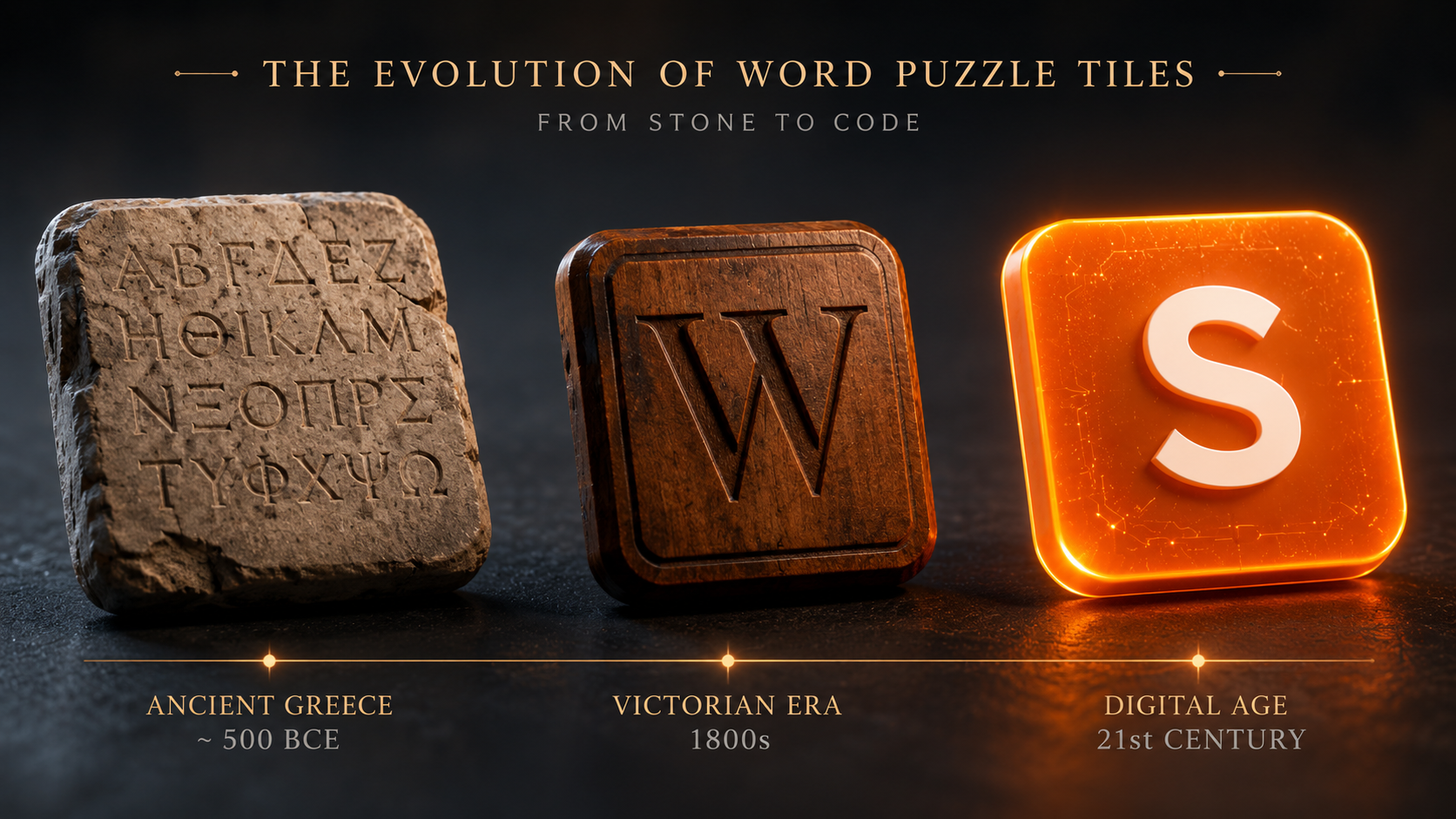
From Ancient Prophecy to Mobile Apps: The History and Evolution of Anagram Games
How an ancient mystical practice evolved into Victorian parlor games, inspired Scrabble, and continues to dominate modern digital puzzle mechanics.
Whether you are unscrambling a daily tile pack in Drubble, tile-snatching in a physical tabletop game, or working out a crossword anagram clue, the act of rearranging letters to reveal hidden words is deeply satisfying.
While anagram games feel like a distinctly modern pastime, humans have been playing with the permutations of language for thousands of years. The story of the anagram spans ancient prophecies, royal courts, Victorian parlors, and modern digital algorithms.
1. Ancient Mysticism & Divine Prophecy (6th Century BCE – Middle Ages)
Long before anagrams were played for points or high scores, they were treated as serious tools for unraveling the mysteries of destiny.
- The Greeks & Romans: The ancient mathematician Pythagoras (6th century BCE) and the poet Lycophron (3rd century BCE) used anagramming to decode names, believing that shuffling the letters of a person’s name revealed hidden truths about their character or future. The Latin term ars magna (“the great art”) is itself a famous, fitting anagram of anagrams.
- Medieval Mysticism: During the Middle Ages, Kabbalistic mystics and religious scholars extensively transposed letters in Latin and Hebrew texts. One of the most famous medieval Latin anagrams is the answer to Pontius Pilate’s question to Jesus, “Quid est veritas?” (“What is truth?”), which rearranges perfectly into “Est vir qui adest” (“It is the man who is here”).
2. Royal Courts & Social Wit (16th – 18th Century)
By the 17th century, the belief in anagrams as prophetic divine signals began to yield to a new identity: intellectual entertainment for the elite.
In France, King Louis XIII famously appointed an official “Royal Anagrammatist” whose sole duty was to compose flattering anagrams out of the names of the king and his courtiers. In England, mastering spontaneous anagrams was considered an essential conversational skill for any proper gentleman, allowing scholars and writers to pass coded messages or witty observational put-downs in literature.
3. The Victorian Parlor Game Era (19th Century)
The 19th century brought two massive shifts: the popularity of literary anagrams pioneered by authors like Lewis Carroll (who famously reshuffled Florence Nightingale into “Flit on, cheering angel!”) and the invention of physical tabletop games.
Instead of simply writing letters on paper, manufacturers began producing sets of wooden, ivory, and cardboard letter tiles. Games officially titled “Anagrams” or “Word Making and Taking” emerged in the late 1800s. Players flipped face-down letter tiles from a central pool to call out words—and crucially, players could “steal” an opponent’s word by adding a letter from the pool and completely rearranging the underlying letters.
Did You Know?
Alfred Mosher Butts, an unemployed architect in the 1930s, grew up playing Victorian tile anagram games. He combined the mechanic of drawing random letter tiles with a scored grid and character frequency weights to create Scrabble—which went on to sell over 150 million sets worldwide!
4. The Digital Revolution & Modern Mobile Word Games
As personal computers, television game shows (like Countdown), and mobile devices spread in the late 20th and early 21st centuries, anagrams proved to be the perfect match for software engineering.
In a physical tile game, finding every valid anagram permutation of a 7-letter rack requires intense manual mental scanning. On a smartphone, however, a custom algorithmic dictionary engine can validate thousands of potential letter combinations in a fraction of a millisecond.
Modern word puzzle games have built on this legacy by introducing new dynamics:
- Daily Synchronized Play: Instead of local tile pools, millions of players across the world receive the exact same daily letter seed to compete fairly on global leaderboards.
- Time-Attack & Rack Management: Combining anagramming speed with tactical tile swapping and score multipliers.
- Algorithmic Tile Balancing: Modern systems filter out impossible letter combinations, keeping racks engaging and competitive every single day.
The Enduring Appeal of Unscrambling
From ancient philosophers seeing divine signs in the alphabet to modern players solving quick daily puzzles on their morning commute, the human brain has an innate love for order, patterns, and language.
Anagram games have survived over 2,500 years because they require no complex setup—just a handful of letters, a vast vocabulary, and a bit of mental agility.